
Mental Health Services for Individuals and Families 

Virginia’s community services boards (CSBs) are the primary point of entry into the Commonwealth’s public behavioral health and developmental services system. CSBs provide treatment for mental health issues, substance use and addiction, and intellectual and developmental disabilities. There is a CSB that serves every county and city in the state.

Find a CSB near you.  

Substance Abuse and Mental Health Services Administration (SAMHSA) treatment locator

Psychology, therapist and happy man talking for help, mental health advice or support in office.

How to Get Help for Mental Health Concerns

Virginia’s community services boards (CSBs) are the primary point of entry into the Commonwealth’s public behavioral health and developmental services system. CSBs provide treatment for mental health issues, substance use and addiction, and intellectual and developmental disabilities. You can also visit the  Federal Substance Abuse and Mental Health Services Administration (SAMHSA) website to find other resources near you. 

弗吉尼亞州的心理健康法

Information about Virginia law governing behavioral health and developmental services can be found in Section 37.2 of the Code of Virginia. Section 37.2 includes statutes governing the emergency custody, temporary detention and involuntary commitment to treatment of individuals in mental health crisis.  

自殺預防 

現在與某人交談 

If you’re thinking about suicide, are worried about a friend or loved one, or would like emotional support, the 988 Lifeline is available 24/7 across the United States. It is available for everyone, free, and confidential. 

Call or Text 988 or visit 988va.org.  
 
Each Community Services Board (CSB) has 24-hour emergency services. Find your nearest CSB

資源 

Lock and Talk promotes limiting lethal means for someone who is suicidal and encouraging them to talk about suicide. This program provides educational materials about suicide and free safety/restriction devices for guns and medications. 

零自殺是一種規劃,培訓和治療模式,用於在健康和行為健康系統中預防自殺。Zero Suicide 採用全系統的方法來改善結果,彌補差距,並改變患者篩查方式和他們接受的護理方式。 

培訓  

Virginia’s Community Service Boards offer several trainings to help clinics, schools, and community groups assist someone who is at risk of suicide. These trainings range from one-hour sessions to intensive, multiple-day interactive trainings.

Trainings provide information about warning signs and steps to how to help someone who is having thoughts of suicide. 

自殺警告標誌

It is important to know the warning signs of suicide. The more of these signs a person shows, the greater the risk of suicide.

  • Talking about wanting to die
  • Looking for a way to kill oneself
  • Talking about feeling hopeless or having no purpose
  • Talking about feeling trapped or being in unbearable pain
  • Talking about being a burden to others
  • Increasing the use of alcohol or drugs
  • Acting anxious, agitated, or reckless
  • Sleeping too little or too much
  • Withdrawing or feeling isolated
  • Showing rage or talking about seeking revenge
  • Displaying extreme mood swings 

我可以做什麼來幫助家人或朋友?  

If you suspect someone may be at risk for suicide, it is important to ask directly about suicidal thoughts.

Do not avoid using the word “suicide” as it does not increase risk of suicide.

Listen to the person non-judgmentally.

Talking things out shows that you care and want to hear their story.

Take a training through your local CSB or reach out to them to get more information.

心理健康急救 

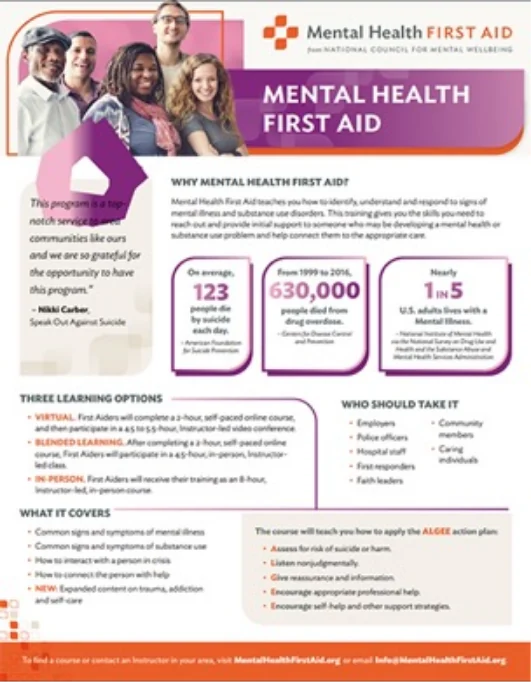
Mental Health First Aid (MHFA) is an eight-hour, skills-based training course that teaches participants about mental health and substance-use issues. MHFA is designed to give members of the public key skills to help someone who is developing a mental health problem or experiencing a mental health crisis and identify multiple types of resources. Just as CPR training helps a layperson without medical training assist an individual following a heart attack, MHFA training helps a layperson assist someone experiencing a mental health crisis. 

For more information on MHFA and the research and evidence behind it, visit the Mental Health First Aid website

To find information on the number of trainings and people trained in MHFA, visit Virginia Prevention Works

Student, anxiety and woman in busy college campus with depression, sad and mental health problems.

There are two main MHFA programs that focus on adults and youth

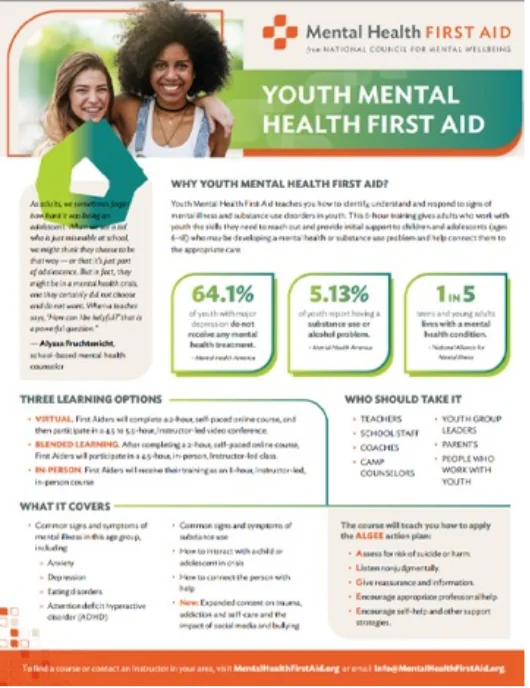
Youth mental health first aid

成人 

Teaches individuals how to recognize signs of mental health and substance use challenges in adults over 18, how to offer initial support, and how to guide someone toward appropriate care. Topics include depression, anxiety, psychosis, and addiction.

Adult mental health first aid

青年 

Teaches parents, family members, caregivers, teachers, or any adult who interacts often with youth how to help a teen (ages 12-18) who is experiencing mental health challenges. This provides an overview of adolescent development and introduces a 5-step action plan to help teens in crisis and non-crisis situations. Topics include depression, anxiety, psychosis, substance use, disruptive behavior, and eating disorders. 

Community Coalitions

Community coalitions work to promote wellness and prevent substance misuse. Virginia is fortunate to have more than 50 volunteer-driven community coalitions. Coalitions include individuals from diverse sectors of the community who share a passion for the health of people and places where they live. 

Coalitions welcome partners such as: youth, parents, businesses, media, educators, youth-serving organizations, law enforcement, faith communities, civic and volunteer organizations, health providers, and other community activists interested in promoting wellness. 

DBHDS provides support for collaboration between staff at the Community Services Boards and local coalitions. Using SAMHSA’s Strategic Prevention Framework[JF1] , coalition members study local conditions and create a roadmap for addressing health issues through a data-driven, environmental approach. 

For people who are interested in volunteering with a community coalition, there are many ways to get involved regardless of prior experience.

A few examples of activities coalition members engage with include: 

  • 舉辦市政廳會議,以解決未成年人飲酒或其他當地關注的議題 
  • 調查社區以了解有關電子煙的態度和知識 
  • Reaching out to community members to share information and explore partnership opportunities
  • Hosting training and educational presentations 
  • Collecting and analyzing local data 
  • Recruiting youth for advisory boards, media campaign design, and peer-to-peer education
     

Learn more about membership and training opportunities at Community Anti-Drug Coalitions of America (CADCA) and state level partner Community Coalitions of Virginia (CCoVA). 

Prevention Works

Virginia is working to address specific behavioral health and substance use issues across the state. Key areas of focus for Virginia’s prevention efforts include: youth alcohol use, youth and adult binge drinking, youth tobacco/nicotine use (cigarette and e-cigarette use), suicide/mental health, and opioid, stimulant, and OTC overdoses and misuse. For an overview of specific behavioral health indicators in VA, visit the Virginia Social Indicator Dashboard (VASIS).

Activate Your Wellness

“Activate Your Wellness” promotes wellbeing through awareness messages and calls to action. The campaign is all about representing positivity, growth, and optimism. We want Virginians to know that it’s okay if their wellness is not where they want it to be because even a small step can help create positive change!

Virginia Telemental Health Initiative (VTMHI)

The Virginia Telemental Health Initiative (VTMHI) expands access to mental health services for un- and under-insured individuals across the Commonwealth by working with Virginia’s free and charitable clinics and pre-licensed mental health providers in the process of completing licensure. 


精神健康及物質使用預防、治療及康復服務組別補助 

As the recipient of federal funds, DBHDS is required to send an annual plan and biennial application to SAMHSA. The Federal Fiscal Year 2026-2027 Combined Mental Health and Substance Use Prevention, Treatment, and Recovery Services Block Grants Application Draft for the Commonwealth has been posted. 

Final public comments regarding last year’s application and the DBHDS response 

For any written public comment or questions about the block grants or the application, please contact communityoperations@dbhds.virginia.gov or by letter at DBHDS- Office of Enterprise Management Solutions P.O. Box 1797 Richmond, VA 23218-1797.